
Leveraging the innovative ideas and driving force unique to academia, we create value and contribute to society.
We are engaged in research on innovative LSI architectures for multimedia processing systems, as well as a wide range of technologies that contribute to society.
Our laboratory consists of five research groups:
• Group 1: Research on microcontroller- and LED-based systems and applications.
• Group 2: Development of processing architectures for embedded devices and their practical applications.
• Group 3: Research on communication security, including GPS-related technologies.
• Group 4: Research on efficient food production in space agriculture facilities.
• Group 5: Research on AI and entertainment applications with a focus on image processing technologies.
We have prepared a variety of live demonstrations showcasing our latest research and developments. We warmly invite you to visit our booth and experience our technologies firsthand.
| Booth No | C-D29 |
|---|---|
| Address | |
| Phone Number | |
| URL1 | https://www.ritsumei.ac.jp/~kumaki/kumaki_hp/index.html |
| URL2 | |
| URL3 |
Product / Service
Group 1 and Group 2
##Connecting Lives Beyond Coverage Areas. A LoRa-Based Search and Rescue Support System for Missing Persons##
〇No Communication Infrastructure Required
Location information can be shared even in areas where cellular networks are unavailable or out of coverage.
〇Long-Range, Low-Power Communication
By utilizing LoRa technology, the system enables reliable information transmission in disaster situations and remote environments such as mountains and offshore areas.
〇Low-Cost Deployment
The system is built using commercially available microcontrollers and wireless modules, eliminating the need for dedicated infrastructure. By employing a license-free communication standard, it can be deployed at a significantly lower cost than conventional rescue systems.
Group 3 and Group 4
##Detecting fake GPS signals.##
・Enhanced Security for Various Electronic Devices
This technology counters GPS misdirection caused by spoofing attacks—a major issue in recent years—by authenticating GPS signals. It significantly enhances the security of many electronic devices equipped with GPS.
・Authentication Using Signal Strength
Authentication is performed using the signal strength of GPS signals. Since this method does not rely on AI, even small microcontrollers can distinguish signals with high accuracy.
・Authentication Using IQ Data
Authentication is performed using IQ data, which represents signals as complex numbers. While this method is more difficult to implement on microcontrollers, it offers higher accuracy and the ability to estimate the direction of arrival of fake GPS signals.
-----------------------------------------------------------------------
##What fluctuation promotes plant growth the most? ~Exploring the optimal fluctuation for increased yield.~##
* Discovering the Light Plants Prefer
By comparing different fluctuations, we explore the optimal light environment for plant growth.
* Applying Natural Fluctuations
Utilizing naturally occurring 1/f^a fluctuations for plant cultivation.
* Potential for Higher Yield
Adjusting light fluctuations to improve productivity in plant factory systems.
-----------------------------------------------------------------------
##Reducing Feed Waste to Zero with AI##
・AI-powered uneaten feed detection
AI uses image recognition to automatically detect uneaten fish feed. This enables data-driven feeding that does not rely on human experience or intuition.
・Automatic optimization of feed amounts
Feed amounts are adjusted in real time based on the amount of uneaten feed. This allows for flexible feeding tailored to the fish’s feeding behavior.
・Contributing to sustainable aquaculture
Reducing feed waste not only cuts costs but also helps prevent water quality deterioration and reduces environmental impact.
-----------------------------------------------------------------------
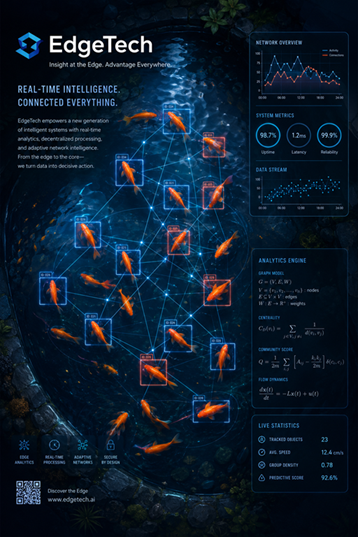
##・Catchphrase Next-Generation Behavioral Analysis System: Fully Automated Quantification of Collective Order in FishSchools
・Key Highlights We have developed a dynamic behavior analysis system for fish schools that integrates deep learning (YOLOv8) object tracking with a Kalman filter. By utilizing AI to analyze fish underwater, the system successfully extracts frame-by-frame state transitions (phase transitions), such as "panic behavior" and "foraging excitement" exhibited by the school in response to external stimuli like feeding. This has enabled the visualization and data quantification of macro-level collective order. This stands as a next-generation behavioral analysis system aimed at advancing smart aquaculture.
-----------------------------------------------------------------------
##Next-Generation Light Environment Analysis System for Visualizing Plant Responses##
In this study, we analyzed how different light qualities affect plant
growth and bioelectric potential using saffron cultivation experiments.
By cultivating plants under various lighting environments, including
sunlight-spectrum LEDs and general white LEDs, we compared plant height,
flowering behavior, and bioelectric potential responses. This enabled the
visualization and quantification of how plants respond to different light
environments.
In addition, we are exploring the sensing of natural light environments
from vegetable-producing regions across Japan and applying these regional
light characteristics to indoor cultivation systems.
In the future, we aim to develop a next-generation environmental control
system utilizing SPA and AI technologies for anomaly detection and
automatic analysis of optimal cultivation conditions.
Group 5
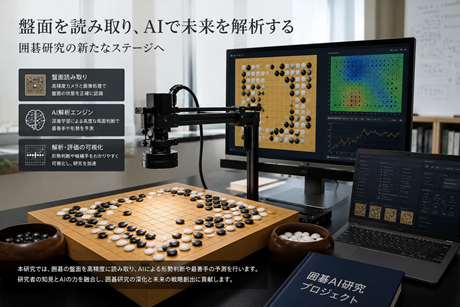
#Just look at the board — AI analysis begins.
1. Just point a camera at a Go board — the game is digitized in real time
2. Three live views reveal exactly what the AI "sees": the camera feed, the normalized board, and the digital virtual board
3. Robust in real-world conditions — 93.5% detection accuracy over a 23.6-minute, 216-move live test, even with hand occlusion and lighting changes
4. Instant SGF (game record) output, ready for AI analysis and game replay
5. No GPU, no cloud required — real-time operation at ~20.5 fps on a standard laptop CPU alone